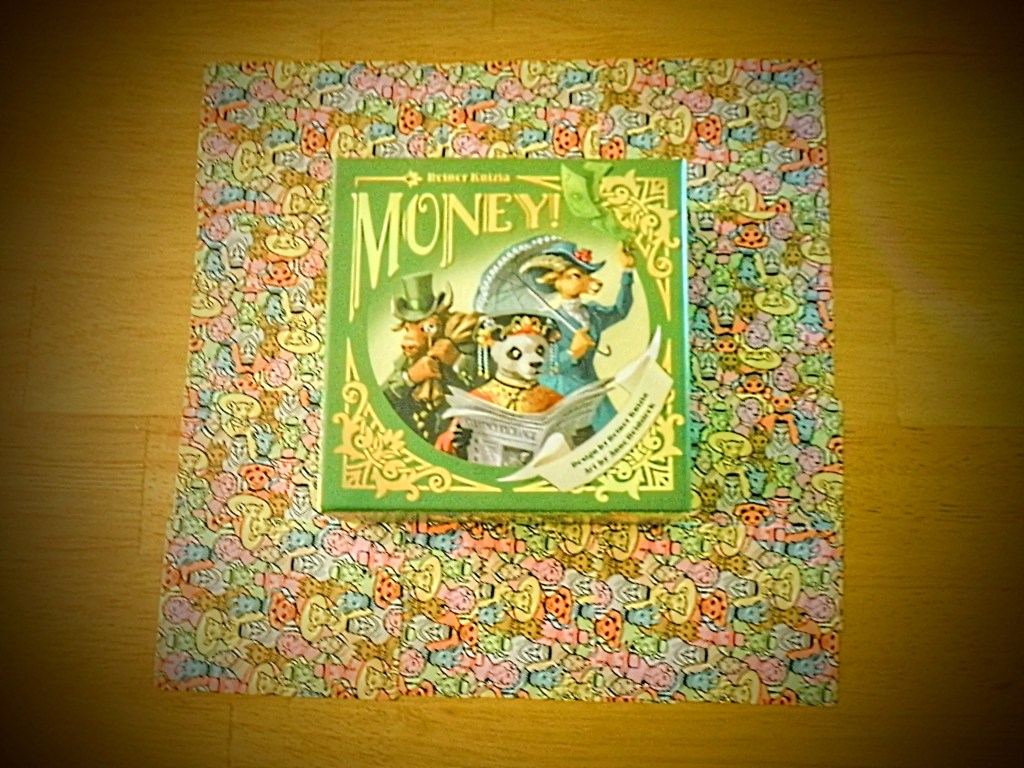
Perhaps the title of this post is slightly hyperbolic. I am well aware that the size of the box does NOT dictate the quality (or depth) of a particular game. Still… There are just a few games that have really surpassed my expectations lately. Namely, the game I am writing about right now… Money (designed by: Reiner Knizia and published by: Allplay) as well as Piggy Piggy (which I will talk about more in-depth later).
But getting back to Money… It is unexpectedly great! My only gripe is that it can be hard to manage the cards in your hand. While it is a minor nitpick that I have with the game, it is definitely something worth noting. Especially for players with sore hands. Might be best to invest in a card holder for this one!
Anyway! What do you actually do in Money? Well, it is a bidding game. A straight-up, no frills bidding game that packs quite the punch! In it, you will start with a hand of about 5 or 6 cards. One of those cards being a value of ZERO (fake money, that you can use to trick your opponent into thinking you are bidding higher than you actually are). And on a turn, you choose a certain number of cards from your hand to bid with. The cards you used to bid can be used in 1 of 3 ways… You can either trade the cards with those in the market OR trade your cards with the cards of your opponent OR, lastly, you can choose to put the cards you used to bid back into your hand. You can rescind the bid, basically.
And that is the flow of the game right there. Bid. Decide how to use your bid from the three options available. Bid again. Keep doing this until the market deck runs out. Add up your points. See who wins! In case of a tie, you share the victory.

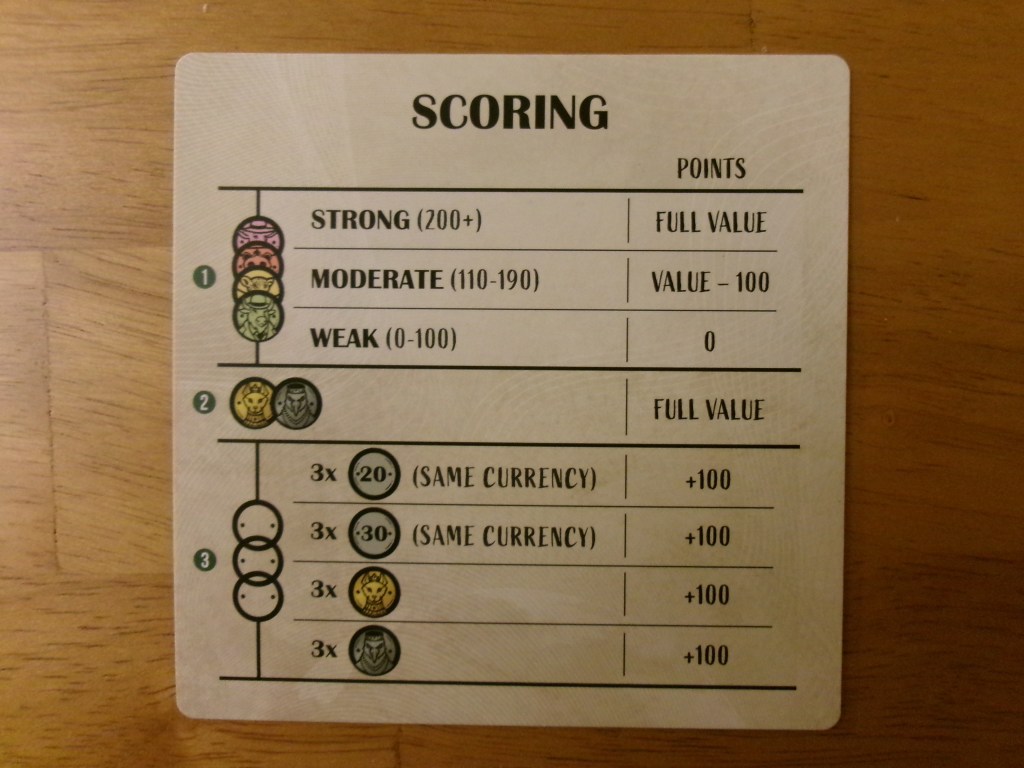
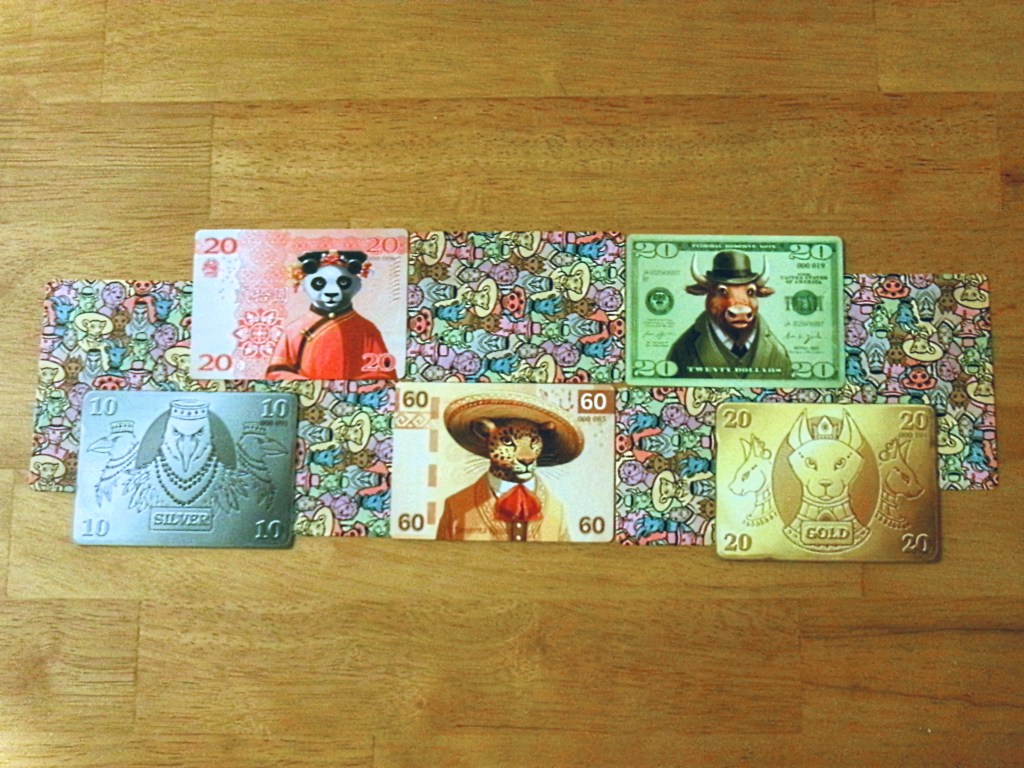
Though, to make it more interesting… Scoring is a bit unique. If you have $200 or more of a specific currency, you score the face value of that currency type. If you have more than $100, but less than $200 in a currency… Then, you subtract $100 from your score. But you also get a bonus $100 for each set of 3 you have. Each currency has three $20s, three $30s, and one each of $40, $50, and $60. Totalling 9 cards for each currency (with 7 different currencies in the game in total).
In a two (or four) player game, you will remove one type of currency. Leaving you with 6 currency types to play with during the game. In a three player game, you will remove two types of currencies. Leaving you with 5 currencies to play with during the game.
So, scoring is not too complicated. But it is definitely a bit different than what I am used to. But I think it helps the player to make more interesting, meaningful decisions throughout the play of the game. In other words, I think it works and I actually do not mind it overall. Though, I can see some people being a bit confused by it. And it is possibly the hardest aspect of the game to teach. Basically, you want to make sure you have the majority of a currency. Optimally, you should look to have all of a specific currency. Because if that is the case, then the max you can score for that currency is $500, not counting the $100 bonus for having sets.
Now, I can understand if the game does not sound all too compelling. But it is a smooth, addictive experience overall. And it is a game where I think you just have to play it to really understand the depth it offers.
Honestly? I bought it based on the artwork alone. I liked the way it looked. I was not expecting to be as enamored by the game and its mechanics as I have been.
To be fair though, too, I enjoy a good bidding game from time to time. And I appreciate that Money is as straightforward as it is. It is also nice to find a bidding game that seamlessly supports two players as those kinds of games and experiences are hard to come by.
To end, I have been listening to a podcast where the hosts are HUGE fans of Reiner Knizia. While I do not share the same love for him, I am starting to finally understand his overall appeal in the tabletop gaming landscape.
Rating: 8.5 out of 10
 PORTFOLIO